Documentation for get_nebular_emission
This code is in beta. Please report issues and be patient with the incomplete documentation.
Get nebular emission
get_nebular_emission is a Python package that given the metallicity of cold gas, the stellar mass and either the specific star formation or the number of ionizing photons, calculates the intensity of nebular emission lines from star forming HII regions. It also calculates the emission lines from narrow-line regions of AGNs from the AGN luminosity and the size and mass of galactic components.
The current version of the code is based on the Fortran90 one used for the paper Baugh, Lacey, Gonzalez-Perez and Manzoni 2022 (https://arxiv.org/abs/2112.00129).
The code expects text or HDF5 files with data of global galactic properties from one or more galaxies. These properties can correspond to any number of galaxy component (for example, disk and bulge), for which the code calculates emission lines independently. Finally, it outputs a HDF5 file with all the results.
It considers two possible sources of emission: star-forming or HII regions and the narrow-line regions (NLR) of AGNs. The spectral emission line luminosities are calculated separately for star-forming or HII regions and the narrow-line regions (NLR) of AGNs. Although the code structure is the same for both ionising origins, different inputs are required. A comprehesive list of the input parameters can be found below.
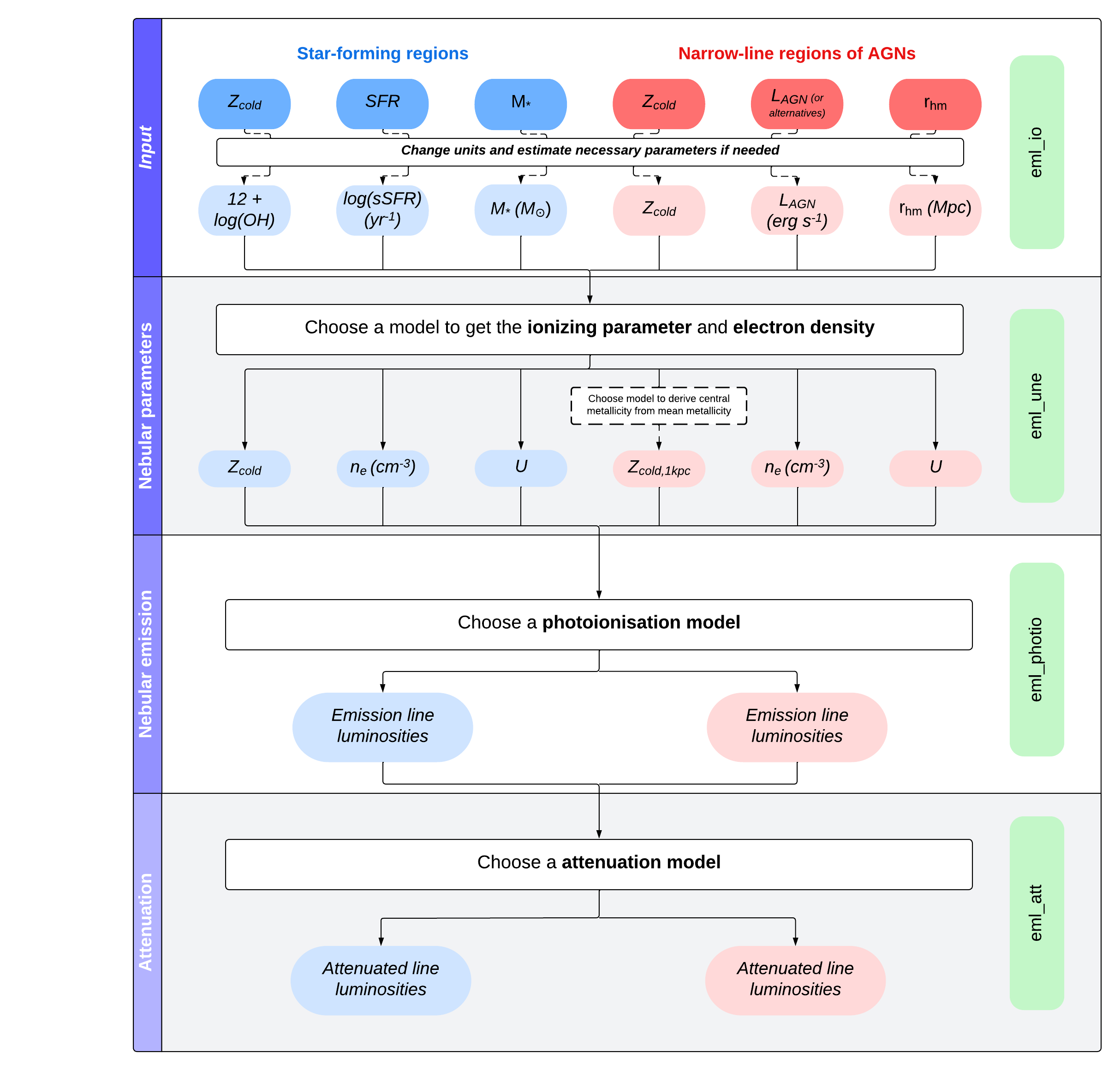
First, global galactic properties are connected to the ionising source, either HII regions or the NLR. Then, a photoionisation model is used to obtain the emission line luminosities given the characteristics of the ionising sources. This is done interpolating the values from predefined photoionisation grids.
As long as the needed input parameters are available, the code can be coupled with model galaxies produced with different codes: hydrodynamical simulations, semi-analytical models, empirical ones, etc. Each part of the procedure is handled by a different module, specified in the flowchart:
Requirements and Installation
This code has been developed in Python 3.7.1 and it is compatible with Python above 3.5 versions. The code has been tested to run in Linux and Windows operating systems.
This code uses numpy as specified in docs/requirements.txt.
The code can be run directly from a cloned GitHub repository and then makeing a local installation from the main directory (where you can see setup.py:
python3 setup.py install.
Tutorial and testing
A brief tutorial going through all the main options of the code is available at run_code_tutorial.py. A more in-depth review of all the options in the code can be found at Expósito-Márquez et. al. 2024 in prep.
run_code_tutorial.py is already prepared to run a z = 0 subvolume of GP20 model galaxies (Gonzalez-Perez et. al. 2020, https://academic.oup.com/mnras/article/498/2/1852/5894931) in the ‘example_data’ directory. The repository also has a program to plot line-ratio diagrams from the output files of the code, with several predefined selection criteria.
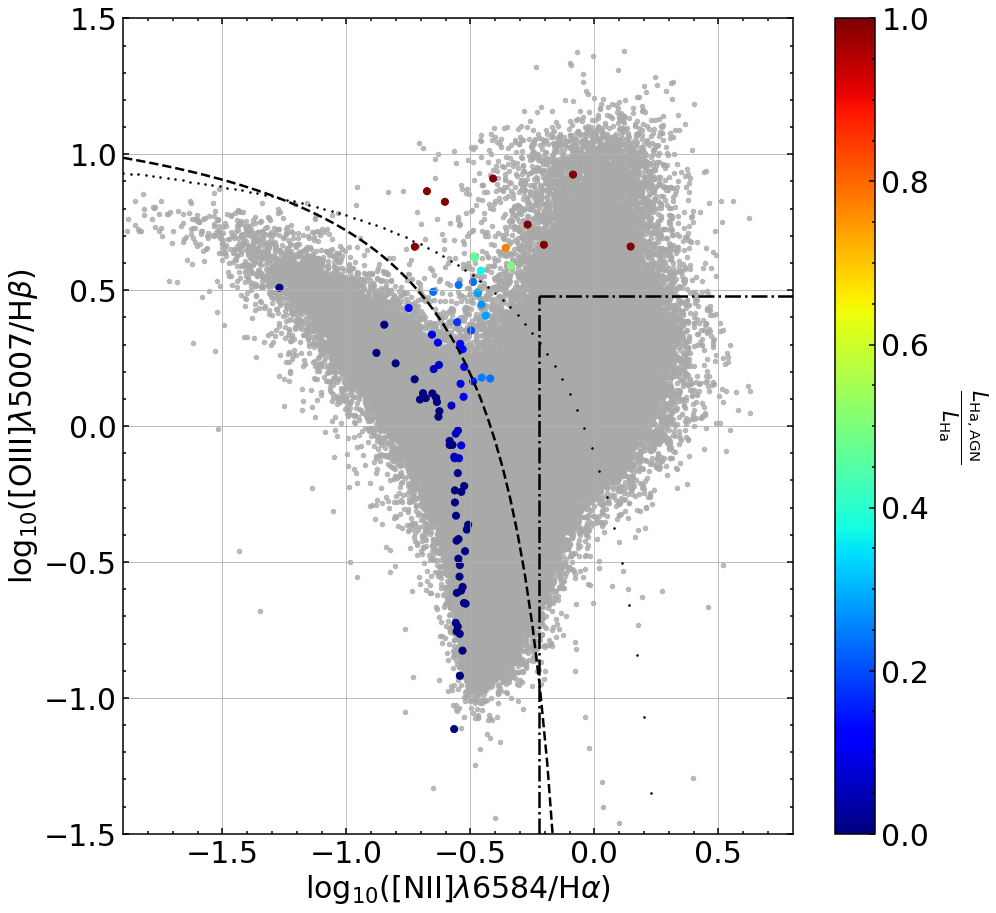
A BPT with the results for the example file without considering attenuation and with the selection criteria for local galaxies from Favole et. al. 2023 (https://arxiv.org/abs/2303.11031) can be seen below for testing purposes.